
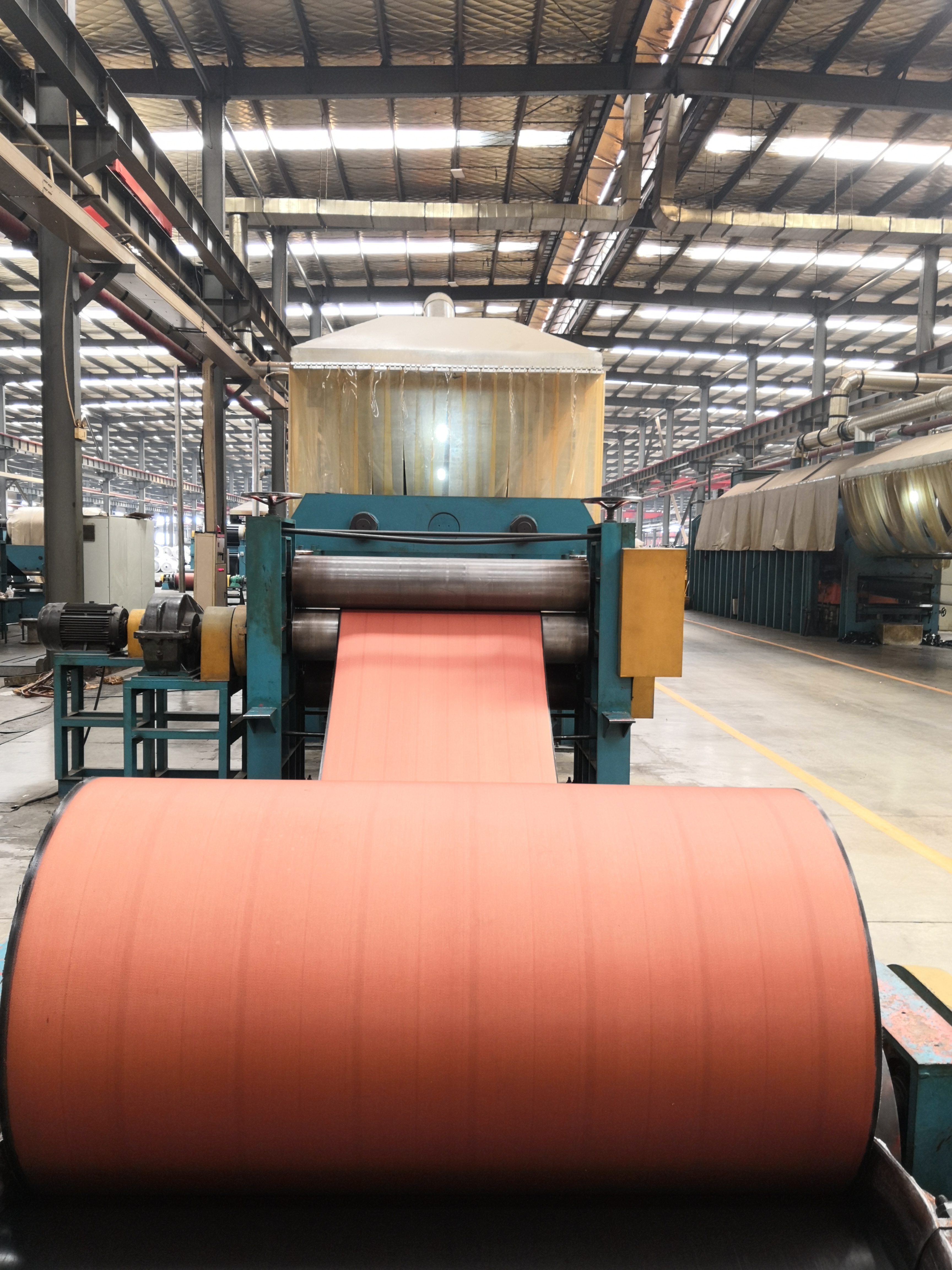
Commissioning procedure of wheel feeding belt
September 18, 2022
1. Before commissioning, confirm whether the centers of all rollers, grooving idlers and return idlers are horizontal and parallel to each other, and adjust them if necessary.
2. Check whether all tools on the belt have been removed.
3. Pre tension the belt to keep the conveyor belt at a proper initial tension.
4. For commissioning, the return section shall be adjusted first, and the operation towards the tail wheel shall be adjusted along the return direction, and then the bearing surface shall be adjusted according to the running direction of the conveyor belt. The following steps can be used.
① Adjustment from the driving roller to the idler according to the running direction of the conveyor belt.
② During adjustment, only slightly adjust one supporting rod within a small range each time; It cannot be adjusted by a large margin, and it is necessary to wait for at least three turns before making the next adjustment.
③ The roller shall be kept perpendicular to the belt operation, and the roller shall not be adjusted as much as possible. The drive roller can be adjusted only when all adjustment methods are invalid.
④ The deflection adjusting roller shaft of the bearing surface shall be aligned from the tail wheel to the head, and the automatic centering idler can be used to prevent the belt from deviating (the best position of the automatic centering idler is near the roller and 10-15 meters away from the roller).
⑤ First, conduct no-load running test, and adjust carefully at the same time.
⑥ The belt should be adjusted slowly and intermittently so that any tendency of belt deviation can be observed quickly and the belt should not be damaged.
⑦ When the conveyor is relatively long, personnel should be arranged to observe every other section, exchange the operation situation in time and take measures. According to the initial movement of the belt, determine the position to be corrected and the correction measures, and first correct the places with damage risks.
⑧ The tensioning device also has a great impact on the regular operation of the conveyor belt, so the tensioning roller shaft must be kept in a horizontal state.
⑨ After the commissioning of the no-load belt is completed, the carrying capacity shall be gradually increased until the belt is fully loaded (under ideal conditions, the material has the same horizontal speed and running direction as the conveyor belt).
⑩ The deviation during loading is usually caused by the accumulation of the lateral impact of the loaded materials off center on the conveyor belt on the buffer roller or return idler. Therefore, it shall be adjusted again to compensate the non central load, and it shall be considered comprehensively to minimize the change of no-load and full load as much as possible.
The belt deviation and abnormal wear caused by the conveyor belt itself are rare. The main reason for these problems is that the conveyor structure or system is not coordinated. During commissioning and operation, these problems will be reflected by the conveyor belt.